 Skip to content

New York one day tour : I booked a one-day guided sightseeing tour expecting a rushed checklist of famous landmarks. What I got instead was a masterclass in how to actually *experience* a city in a compressed timeframe—complete with a guide who understood that New York isn’t just about the monuments, but the stories behind them.
What’s in This Guide
- Tour Overview & What to Expect
- Times Square: Bright Lights & Urban Energy
- Central Park: A Guided Walk Through the City’s Heart
- Iconic Landmarks: Fifth Avenue & Beyond
- The 9/11 Memorial: The Day’s Most Powerful Moment
- Ferry Ride & Statue of Liberty: The Perfect Finale
- Is This Tour Worth It? An Honest Assessment
- Practical Information & Booking
Tour Overview: What You’re Actually Getting
The tour departs from Midtown Manhattan on a comfortable air-conditioned bus. From that first moment, you understand the game plan: you’re not walking New York, you’re being *shown* New York. The guide handles the navigation. The bus handles the logistics. You handle the sightseeing.
In six hours, you hit Times Square, Central Park, the most iconic blocks of Fifth Avenue, the 9/11 Memorial, and—for the grand finale—a ferry ride across New York Harbor to the Statue of Liberty. It’s not leisurely. It’s not deep. But it’s efficient, well-paced, and surprisingly effective at giving you a sense of New York’s scale and personality.
The real differentiator isn’t the stops—most first-time NYC visitors will see all of these eventually. It’s the storytelling. The guide doesn’t just point out the Flatiron Building. They explain how its unusual triangular shape changed NYC architecture. They don’t just drive past St. Patrick’s Cathedral. They talk about what it meant during different eras of the city’s history. This context transforms a sightseeing tour from a photo op checklist into something more thoughtful.
Times Square: Bright Lights & Urban Energy
The tour starts with a drive through Times Square, and I’ll be honest—it’s overwhelming in the best way. The neon. The screens. The sheer density of humanity. If you’ve never seen Times Square, no photo prepares you for the intensity of it in person.
Our guide pointed out which buildings house the most expensive real estate in the world. Which brands are splashing millions on the biggest screens. The history of how this neighborhood transformed from red-light district to corporate advertisement theme park. These details matter because they help you understand that Times Square isn’t just a tourist destination—it’s a complex reflection of American capitalism and pop culture.
We didn’t stop here, which was the right call. A 20-minute photo break at Times Square is long enough. This tour keeps momentum.
Central Park: A Guided Walk Through the City’s Heart
This is where the pace slows. You disembark the bus and actually walk. Central Park is enormous—843 acres. You could spend days here and miss things. A one-hour guided walk obviously can’t show you everything, but our guide made smart choices about what mattered most.
We walked through the main thoroughfares: Bethesda Terrace, the Bow Bridge, the open areas where you can see the surrounding buildings and grasp just how much *park* is wedged into the middle of Manhattan. Our guide talked about Frederick Law Olmsted’s original vision—not a garden, but an escape hatch from the city. A place where New Yorkers could feel nature without leaving Manhattan.
The walking pace was manageable. The guide pointed out architectural details and historical moments without making it feel like a lecture. By the end, I had a genuine appreciation for why New Yorkers love this place. It’s not just green space. It’s proof that careful urban planning can carve out tranquility in a city of 8 million people.

Iconic Landmarks: Fifth Avenue & the Architectural Journey
After Central Park, you re-board the bus for a curated drive down and around Fifth Avenue. This is where the tour shows its strength: context.
We passed Rockefeller Center and the guide explained its role during the Depression. St. Patrick’s Cathedral and the guide talked about its Gothic architecture and what it represented during different eras of immigration. The Flatiron Building—the guide explained the engineering marvel of its design and why its unusual shape was so revolutionary. The New York Public Library—not just a beautiful building, but a symbol of public access to knowledge.
These aren’t just pretty buildings. They’re chapters of New York’s story. The guide made that clear.
The bus also drove past countless other architectural landmarks—some you’d recognize, many you wouldn’t. The point is that by the end of this portion, you’ve begun to understand New York as a city that *layers* its identity through architecture. Every era left its mark. Every neighborhood reflects different values and economic moments.
The 9/11 Memorial: The Day’s Most Powerful Moment
After a lunch break near the World Trade Center, we returned to visit the 9/11 Memorial.
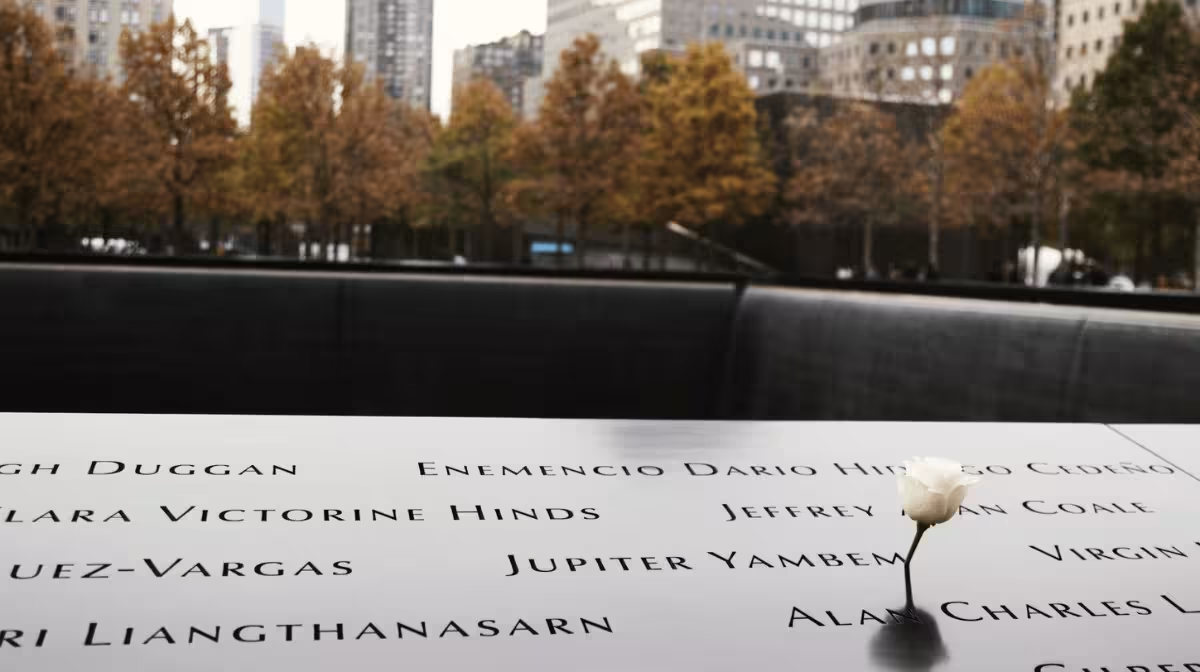
I need to be honest about this: nothing prepares you for the emotional weight of standing beside those memorial pools. The symmetry. The water flowing into the center. The names engraved around the edges—nearly 3,000 of them. It’s not a tourist attraction in the traditional sense. It’s a place of grief and remembrance.
Our guide understood this. They didn’t treat it as just another stop on a checklist. They stood with us, shared context about what we were seeing, and gave us time to absorb it. There was a quiet respect to how this part of the tour was handled.
The guide talked about the resilience of New York and New Yorkers in the aftermath. How the memorial itself represented both mourning and rebirth—the reflecting pools surrounded by the new One World Trade Center, a building designed to be taller than the original towers. It’s not a separate narrative from the rest of New York’s story. It’s a part of it.
For many first-time visitors, this becomes the emotional anchor of their NYC trip. Not Times Square. Not the Statue of Liberty. This moment, standing with 3,000 names, understanding the scale of loss and the commitment to remembrance.
Ferry Ride & Statue of Liberty: The Postcard Perfect Finale
The tour ends with a ferry ride across New York Harbor to the Statue of Liberty. After the emotional intensity of the memorial, this is a palate cleanser—and that’s exactly what it needed to be.
The ferry ride itself is spectacular. You get the full panorama of the Manhattan skyline receding behind you. Ellis Island comes into view. And then the Statue of Liberty emerges from the harbor—larger than photos suggest, more imposing than you’d expect.
Our guide gave context: the gift from France, the symbolism of liberty and immigration, the history of who came through Ellis Island and what they were seeking. But mostly, the guide let the moment breathe. You’re on a ferry boat. The Statue of Liberty is in front of you. The Manhattan skyline is behind you. The light was golden as we approached sunset. It’s a postcard-perfect moment, and the tour doesn’t try to over-explain it. It just lets you experience it.
By the time we returned to Midtown (about 6 hours after we’d started), I felt like I’d experienced something genuine. Not a deep dive. Not an expert’s tour. But a real introduction to New York that hit the emotional and narrative beats that matter.

Is This Tour Worth It? An Honest Assessment
The Verdict: Yes—With Caveats
Best for: First-time visitors, families with limited time, people who want to see major landmarks without the stress of navigating on their own, anyone wanting context and storytelling alongside sightseeing.
Not ideal for: Experienced NYC visitors looking for deep dives into specific neighborhoods, people who prefer independent exploration, anyone wanting more than 1-2 hours in any single location, travelers with mobility issues (bus + walking involved).
The trade-off: You see a lot in six hours, but you experience each location briefly. Central Park deserves at least half a day. The 9/11 Memorial deserves longer than a 20-minute stop. Fifth Avenue could be explored for hours. You’re getting highlights, not deep experiences.
But here’s why it still works: For people visiting NYC for the first time with limited time, this tour does something valuable: it gives you a framework for understanding the city. You see where things are. You hear stories that connect them. You get a sense of New York’s layered identity. That framework becomes valuable when you come back and want to explore more deeply.
The real strength is the guide. A good guide—someone who understands that sightseeing should be about story, not just sights—transforms this from a checklist tour into something more meaningful. Our guide was exactly that.
Practical Information & Booking
How to Book
Book through Viator, which partners with multiple tour operators. Viator handles logistics, cancellation policies, and customer support. You’ll choose your preferred date and time, and the specific bus company/guide will be assigned closer to the tour date.
Reserve Your NYC One Day Tour
Six hours, major landmarks, engaging storytelling, and a ferry finale. Perfect for first-time visitors or anyone short on time.
Book on ViatorPacking & Preparation Tips
The Bottom Line
This tour works because it understands something important: New York is overwhelming. There’s too much to see, too much to understand, too many ways to get lost. A good guided tour doesn’t try to show you everything. It shows you the *right* things in the *right* order, with context and storytelling that helps you understand why those things matter.
By the time you return to your hotel after six hours, you’ve seen iconic landmarks, walked through the most famous park in the world, been moved by a place of remembrance, and stood in front of the Statue of Liberty. You’ve also begun to understand New York’s narrative—its history, its ambition, its contradictions, its resilience.
That’s not nothing. For a first-time visitor with limited time, it’s exactly what you need.