 Skip to content
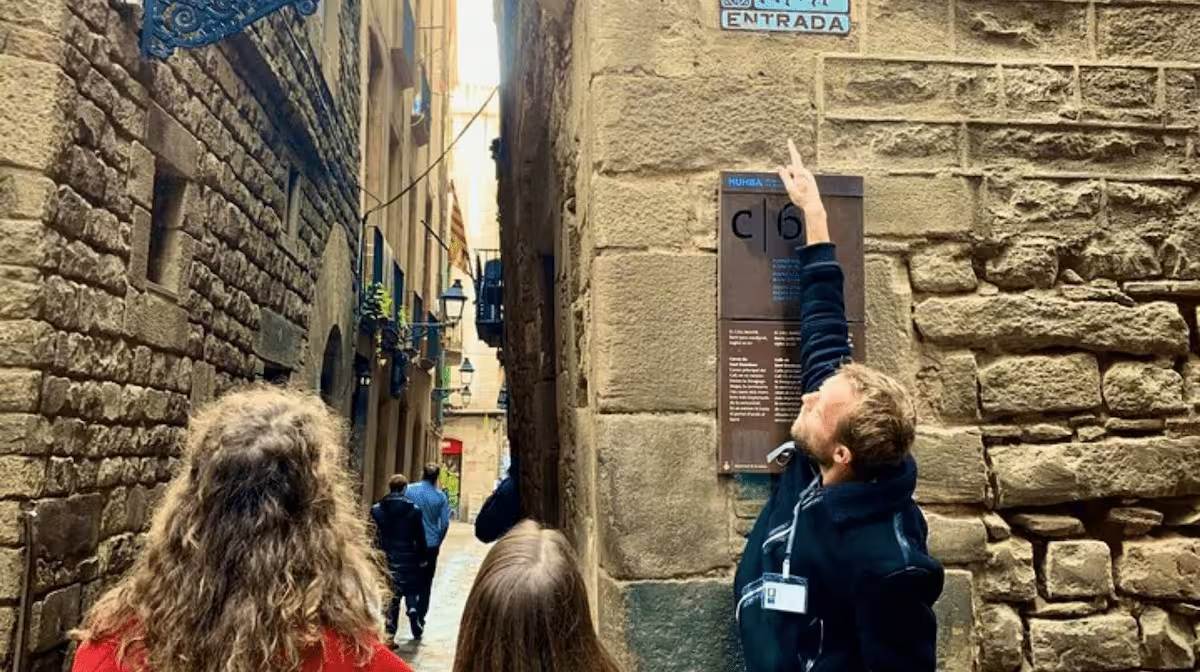
You can walk through the Gothic Quarter Barcelona alone and see old buildings and narrow streets. But you won’t understand it. Understanding takes layers — someone who can point to a pile of ancient stones and say “This was a Roman wall from the 1st century AD,” and suddenly you’re standing inside two thousand years of history. Understanding takes noticing that the medieval streets curve exactly where they do because they were designed to be defended. It takes standing in a quiet square and realizing the scars on the church wall are from bombs dropped in 1938, not ancient siege damage. I took a guided tour of Barcelona’s Gothic Quarter, and it transformed not just how I see that neighbourhood, but how I see the entire city. This guide covers the actual history and facts of the Gothic Quarter — the Roman settlement, medieval rise to power, Gothic architecture, Civil War scars — so you understand what you’re looking at and why it matters. And how to experience it the way that makes it come alive.
Ready to book a guided tour?
The Viator Old Town and Gothic Quarter walking tour covers all the major sites (Roman walls, Cathedral, medieval streets) and runs about 3 hours. Book the guided tour
Contents Show
- 01Roman Barcelona: Barcino and the walls
- 02Medieval Barcelona: a trading empire rises
- 03Gothic architecture: why it matters
- 04The Cathedral: symbol of medieval power
- 05The Civil War: modern scars in medieval stone
- 06What to see and what it means
- 07How to actually understand the Gothic Quarter
- 08Questions answered
Roman Barcelona: Barcino and the Walls
Barcelona’s history begins in 27 BC with a Roman garrison town called Barcino, founded during the reign of Caesar Augustus. It was small — maybe 2 hectares — with 3,000 to 5,000 inhabitants. Soldiers, traders, service workers. Strategic location: a defensible hill overlooking the Mediterranean, with routes to inland trade. For nearly 400 years it remained stable, profitable, and largely unremarkable.
The Romans laid it out in a grid. The main street, the cardo maximus, ran north-south. The cross street, the decumanus maximus, ran east-west. This grid still underlies the Gothic Quarter’s street plan today. Around the settlement, they built a defensive wall approximately 2 metres thick and 10 metres high. Those same stones — weathered by two thousand years, darkened and worn smooth — still stand today. You can walk past a medieval building and see Roman stonework at its foundation. You can touch a wall that was built when Barcino was a small Roman outpost and feel the weight of time in the texture of the stone.
The walls defined Barcino’s extent. When the medieval city developed 800 years later, it grew inside the Roman perimeter. The narrow, winding medieval streets were laid out within boundaries established by Augustus. So even now, walking the Gothic Quarter, you’re constrained by space a Roman general mapped out in the 1st century AD. Two thousand years, and the walls still matter.
Barcino never became a major city like Tarragona. It was secondary, stable, forgotten. But stability was rare after Rome fell. When the Western Empire collapsed in the 5th century, most settlements withered or disappeared. Barcino survived. Shrank, yes. Changed, certainly. But survived. The walls remained. The grid remained. The location remained valuable. This continuity — this 2,000-year thread of habitation and significance — is unusual in European cities.
Medieval Barcelona: A Trading Empire Rises
By the 11th century, Barcelona was emerging as a centre of power. The County of Barcelona, ruled by the House of Barcelona, grew wealthy through maritime trade. By the 13th century, it had become the capital of a Mediterranean trading empire. Catalan merchant ships carried wool, wine, grain, and luxury goods across the sea. Merchants accumulated enormous wealth. The aristocracy built palaces. The city government, merchant guilds, and the Church competed fiercely for space and influence.
This boom was visible in construction. The Gothic Quarter’s character is almost entirely medieval — built during this era of prosperity (roughly 12th-15th centuries). Every major building you see was built when Barcelona was at its economic peak. A poor city doesn’t build magnificent cathedrals or commission elaborate stone palaces. A wealthy city that wants to display its power does.
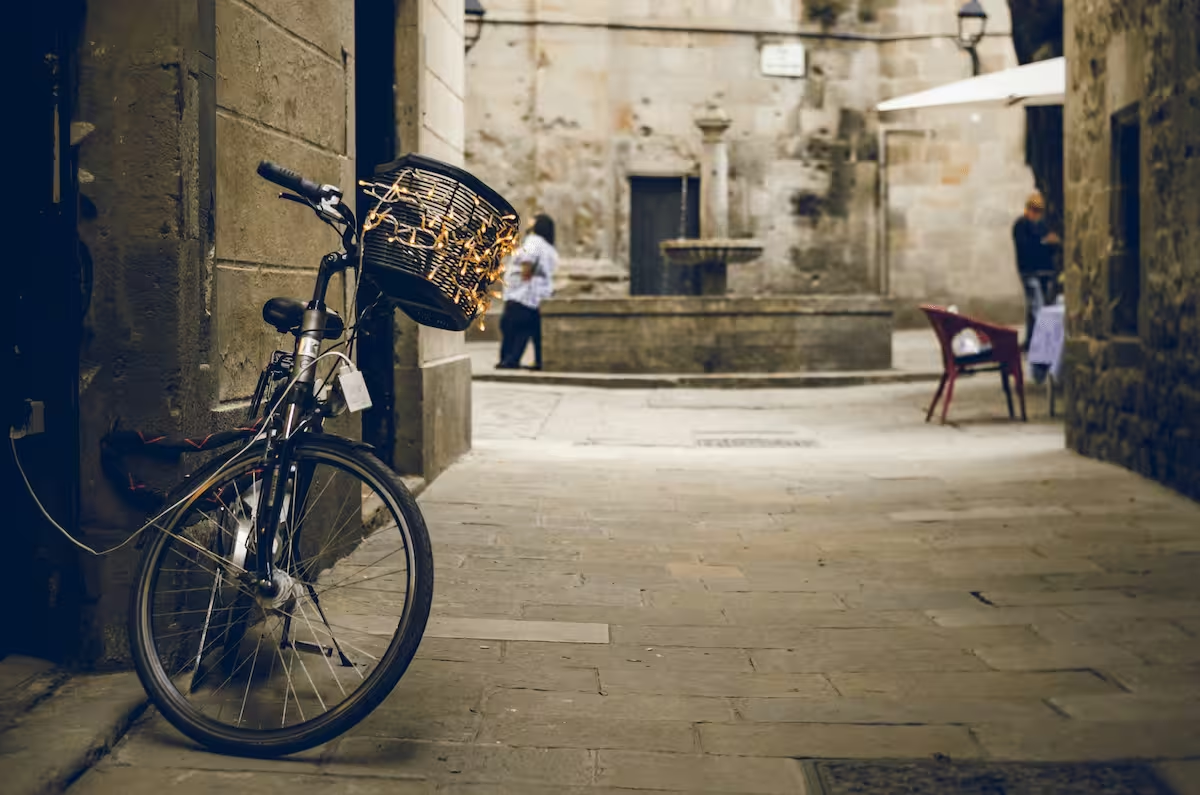
The street layout reflects this power. It wasn’t random. The Cathedral was positioned centrally. Government buildings, merchant houses, guild halls were clustered nearby. Grand plazas for public gatherings. Narrow streets for defence and crowd control. Hidden courtyards for private business. Every element served both practical and symbolic purposes.
Gothic Architecture: Why It Matters
Gothic architecture emerged in the 12th century as a technical and aesthetic revolution. The key innovation: the pointed arch. This seemingly small change had enormous consequences.
A pointed arch distributes weight more efficiently than a rounded arch. Medieval builders could now build taller and thinner without collapsing. Reach skyward without heavy walls. Taller walls meant larger windows. Light flooded in. Gothic churches were bright; Romanesque churches were dark. Light had practical meaning and spiritual meaning — it represented heaven, divine presence, enlightenment. Everything in Gothic design pointed upward. Pointed arches, vertical ribs, soaring heights. The eye follows upward. Medieval theology taught that heaven was above, the soul should aspire upward. The architecture embodied that theology.
Barcelona’s version — Catalan Gothic — was distinctive. Less ornate than French or English Gothic. Emphasis on proportion and space rather than expensive decoration. Broad, soaring interiors. Clean lines. This reflected both Mediterranean aesthetics and the wealth that allowed quality materials and skilled labour rather than ornamentation.
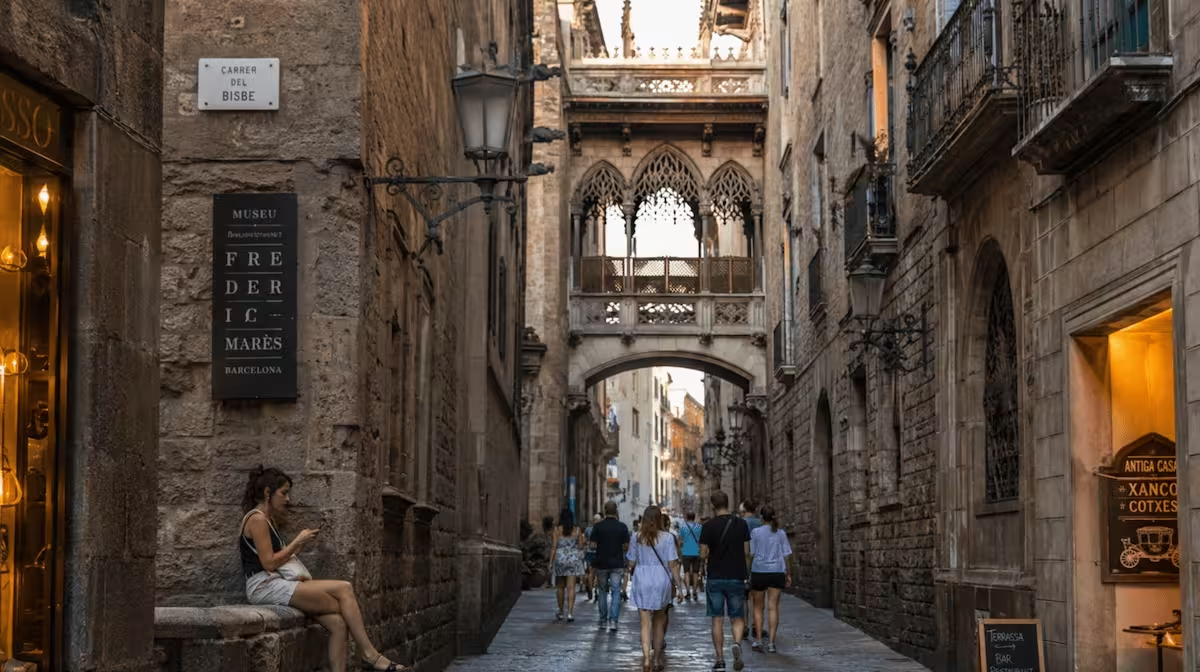
When you walk through the Gothic Quarter and see pointed arches, large windows with stone tracery, vertical emphasis, carefully proportioned facades — you’re seeing medieval engineering and theology made visible. The architecture wasn’t arbitrary. It solved real structural problems and expressed real beliefs about the world.
The Cathedral: Symbol of Medieval Power
Barcelona Cathedral (La Seu) dominates the Gothic Quarter, and understanding it is essential to understanding the neighbourhood. Construction began in 1298 on a site that had hosted sacred buildings for centuries — first a Roman temple to Santa Eulalia, then a Romanesque cathedral. The decision to demolish a functioning cathedral and replace it with something grander was a statement: Barcelona was wealthy enough, powerful enough, confident enough to do this.
The Cathedral took over a century to build. Construction continued through the 14th and 15th centuries. The main Gothic structure was largely complete by the early 15th century, but the famous west-facing facade — with soaring pointed arches, elaborate stone tracery, four towers — wasn’t completed until the 19th century. It was built to medieval designs, so technically the Cathedral you see today is multiple periods unified around one Gothic concept.
Inside are 28 side chapels, each built and maintained by wealthy merchant families or guilds. Each is a small architectural statement — a family’s piety, wealth, status. The Cathedral contains the tomb of Saint Eulalia, Barcelona’s patron saint. Her relics made it a pilgrimage site. Pilgrims brought money, which funded more construction.
Medieval cathedrals served three functions. Spiritual (seat of the bishop). Civic (gathering place for public assemblies). Economic (magnet for pilgrims and wealthy visitors). The Cathedral’s prominence reflects all three.
The Civil War: Modern Scars in Medieval Stone
Barcelona’s Gothic Quarter survived 1,600 years relatively intact. Then came the Spanish Civil War (1936-1939). Barcelona was a Republican stronghold. Franco’s Nationalist forces attacked from the air. Bombs fell on medieval streets. Buildings were destroyed or damaged.
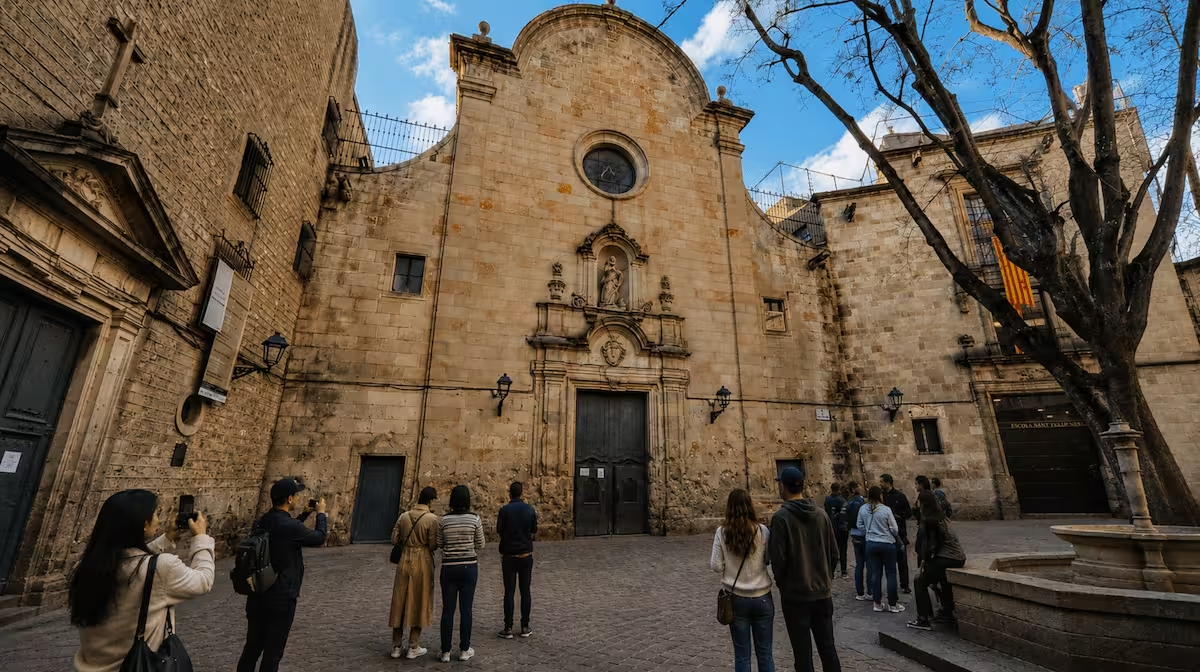
The most visible scars are at Plaça Sant Felip Neri, a small medieval square in the heart of the Gothic Quarter. Our guide brought us there on the tour. The square had been peaceful, almost hauntingly quiet. Then he pointed to the church wall facing the square. The scars were visible immediately — bullet holes, shrapnel marks, dark streaks where shrapnel had torn into the stone. From 1938. Within living memory. Residents who are 90 today lived through the bombing. Standing there, looking at those marks, the mood shifted completely. We’d been taking photos, laughing, making discoveries. Suddenly we were quiet. The scars reminded us that the Gothic Quarter’s history isn’t ancient — it’s continuous. Roman conquest. Medieval prosperity. Modern warfare. All visible in the same spaces.
After the Civil War, Barcelona was under Franco’s authoritarian regime (1939-1975). The Gothic Quarter became a tourist attraction, a symbol of Barcelona’s medieval grandeur. But tourism was complex — the regime wanted Barcelona’s past to represent Spanish (not Catalan) identity. The Gothic Quarter’s medieval Catalan character was preserved, but in a context of political suppression. This complex relationship between heritage, identity, and politics shaped how the neighbourhood was restored and maintained.
What to See and What It Means
Barcelona Cathedral (La Seu): Begun 1298, construction continued through medieval and modern periods. 28 chapels, cloister, tomb of Saint Eulalia (patron saint). Entry fee approximately 7-8 euros. The physical and symbolic heart of medieval Barcelona. When we approached it through the maze of medieval streets on our tour, the massive Gothic facade seemed to appear out of nowhere. I remember looking up and realizing how tiny I felt beneath the towering spires. The guide shared stories about Saint Eulalia and the Cathedral’s role in Barcelona’s past, and it transformed the building from a beautiful landmark into something much more meaningful — not just impressive architecture, but a focal point of a city’s spiritual and political life for centuries.
Plaça Sant Felip Neri: A small medieval square with the church of Santa Felipa. Church walls bear visible scars from Civil War bombing (1938). The square represents two historical layers: medieval Barcelona (layout, Gothic architecture) and 20th-century conflict (visible damage). One of the quietest places in the Gothic Quarter. Worth lingering.
Roman walls: Authentic 1st-century Roman stonework is visible at several locations: incorporated into medieval buildings, visible at street level near the Cathedral, at Plaça Reial. These stones are 2,000 years old. When our guide pointed out the actual Roman stones at the base of a medieval building, it clicked — you’re not just looking at old architecture, you’re looking at the physical layer where one era built on top of another.
Plaça Reial: Large medieval square surrounded by 19th-century neoclassical buildings. Built in the 19th century on a site that was medieval before being cleared for redevelopment. Now a busy tourist hub with restaurants and shops, but the underlying medieval spatial structure remains.
Carrer del Bisbe (Bishop’s Street): One of the main medieval routes through Barcelona. Lined with medieval buildings. The street’s winding nature reflects medieval urban planning — narrow for defence, corners to limit visibility, designed for crowd control.
The Call (Jewish Quarter): A section of the Gothic Quarter that was home to one of Spain’s most important medieval Jewish communities. Developed 11th-12th centuries, it was a dense neighbourhood with its own government, synagogues, community institutions. Jews were expelled from Spain in 1492. Much was destroyed or rebuilt over centuries, but some medieval buildings remain. It represents a lost community integral to medieval Barcelona’s character.
How to Actually Understand the Gothic Quarter
You can walk the Gothic Quarter three ways: alone, with a guidebook, or with a guide. Each gives you a different understanding.
Alone: You’ll see medieval streets, old buildings, the Cathedral. Notice the narrow lanes and winding paths. You might notice Roman stones if you look closely. Without context, you won’t understand why things are arranged as they are. Why do the streets curve that way? What makes the architecture significant? Why does this square look the way it does? These questions are harder to answer alone.
With a guidebook: Better. You’ll understand the grid reflects Roman street planning. Gothic architecture served practical and spiritual purposes. Civil War scars are historically significant. You get context. But it’s passive — reading about it versus experiencing someone explain it in real time.
With a guide (recommended): The difference is profound. A knowledgeable guide explains things as you walk, pointing to specific architectural features, explaining historical significance. The Viator Old Town and Gothic Quarter walking tour covers the major sites (Roman walls, Cathedral, medieval streets, Plaça Sant Felip Neri) and runs about 3 hours. Cost is reasonable for the depth of knowledge. A guide can answer questions, explain connections between different periods, highlight details you might otherwise miss. Our guide didn’t just point at buildings — he made us imagine the Roman settlement, showed us how medieval streets were designed for defence, explained what the Civil War scars meant.
The best approach: take a guided tour first (to understand the framework), then return alone to explore at your own pace. When you understand the history, the Gothic Quarter reveals details you’d miss on a first solo walk. That evening, I returned to several places we’d visited on the tour. The streets were busier, lights were different, tourists filled the squares. But because of the guide’s knowledge, I saw something completely different. I wasn’t just looking at Barcelona anymore — I understood it.
Practical Information
Best time to visit: Early morning (before 10:00) or late afternoon (after 16:00). Midday crowds are heavy with tour groups. Weekday mornings are quieter.
What to wear: Comfortable walking shoes. Streets are uneven, winding, cobblestones throughout. You’ll be on your feet for hours.
Getting there: Metro stop Jaume I (lines 1 and 4) is right at the edge. Plaça Catalunya is walking distance (10 minutes). The Gothic Quarter sits between Plaça Catalunya and the waterfront, fitting naturally into most Barcelona itineraries. See our complete Barcelona guide and 3-day Barcelona itinerary, both of which feature the Gothic Quarter as a key stop. If you’re considering where to stay in Barcelona, the Gothic Quarter itself is a neighbourhood worth staying in for the atmosphere.
Time to spend: Guided tour: 2-3 hours. Self-guided: 2-4 hours depending on how long you linger. To properly absorb the history and architecture, 3-4 hours is ideal.
Entry fees: Most streets and squares are free. Cathedral: approximately 7-8 euros. Museums have separate fees. Some buildings are private residences (no entry).
Questions Answered
- What is the Gothic Quarter?
- The oldest part of Barcelona, built on the Roman settlement of Barcino (founded 27 BC). Medieval neighbourhood with narrow streets, Gothic architecture (13th-15th centuries), and visible Roman walls incorporated into medieval buildings.
- How old is the Gothic Quarter?
- Roman settlement: 27 BC. Medieval development: 11th-15th centuries. Continuously inhabited for 2,000 years.
- Why are the streets narrow and winding?
- Medieval design. Narrow streets were defensive (easier to protect), provided shade, and were constrained by existing Roman walls from the 1st century AD.
- Can I see the Roman walls?
- Yes, in several locations. Authentic 1st-century Roman stone is visible incorporated into medieval buildings or at street level. You can touch 2,000-year-old stones.
- What’s the most important building?
- Barcelona Cathedral. It represents medieval Barcelona’s religious and civic authority. Also visit Plaça Sant Felip Neri for the Civil War history visible on the church walls.
- Is a guided tour necessary?
- No. You can explore alone and see the architecture. A guide provides historical context and explains why things are arranged as they are, what layers you’re seeing, and what individual buildings meant historically. The difference in understanding is significant.
- How long should I spend in the Gothic Quarter?
- At least 2-3 hours with a guide, or 2-4 hours self-guided. To absorb the history and architecture properly, 3-4 hours is ideal.
- What’s the connection between Roman and medieval Barcelona?
- Medieval Barcelona was built inside the Roman walls. The walls defined Barcelona’s spatial extent for 1,600 years. Even today, the Gothic Quarter’s boundaries roughly follow the original Roman perimeter.