 Skip to content
I’d wanted to visit Naples for years and somehow never got round to it. I think it was a childhood impression of the city’s old reputation that I’d never really questioned — because I had been to Pompeii, Vesuvius, Capri, Sorrento, and the Amalfi Coast on earlier trips to the region, just never to Naples itself.
That changed on a short break tacked onto a trip to watch Roma play in Rome — the connecting flight to Naples was cheap and easy, so we figured, why not spend a couple of days there first. I’m glad we did. Naples turned out to be one of the most genuinely fascinating cities I’ve been to in Italy — the culture, the food, the sheer density of history packed into narrow streets. It’s not polished the way Rome or Florence are, but that’s exactly what gives it its character, and I’ll be going back.
This Naples bucket list is built around that trip, plus the surrounding sights — Pompeii, Capri, the Amalfi Coast, Sorrento — we’d already ticked off on earlier visits to the region. Together they make Naples one of the best-placed home bases in southern Italy.
Table of Contents Show / Hide
Explore Pompeii
Pompeii is the single most-visited archaeological site in Italy, and it earns that reputation the moment you walk through the gates. The Roman city was buried under volcanic ash when Vesuvius erupted in 79 AD, which is exactly what preserved it so completely — you’re walking down real Roman streets, past real Roman shops and houses, with the volcano that did it all still looming in the background.
A guide is worth it here — Pompeii is enormous, and it’s easy to spend two hours seeing far less than you should. A licensed archaeologist will get you to the Forum, the Thermal Baths, the Great Theatre, and the plaster casts without the wrong turns.
We did this one on an earlier trip to the region, before Naples itself was ever on the itinerary, and it’s the kind of site worth doing at least once.
Climb Mount Vesuvius
Vesuvius is the only active volcano on the European mainland, and you can walk right up to the crater rim. The path to the top is a manageable, well-marked trail — no technical hiking required — and the payoff is a view over the entire Bay of Naples, with Pompeii, Sorrento, and Capri all visible on a clear day.
Pair it with Pompeii for one full day out of Naples — most tours combine the two, since both sit along the same road out of the city.
Wander Centro Storico

Naples’ historic center has been a UNESCO World Heritage Site since 1995, and it’s less a single street than an entire layered city — Greek foundations, Roman streets, medieval churches, and Baroque facades stacked on top of each other along Spaccanapoli and Via dei Tribunali. Stop into San Gregorio Armeno for the famous nativity-scene workshops, and don’t skip the Quartieri Spagnoli, the Spanish Quarter west of Via Toledo, where laundry lines cross the alleys overhead and murals cover entire building facades.
This is a neighborhood best explored slowly, ideally with a local guide who can point out the stories behind the street art and the churches you’d otherwise walk straight past.
We started at Piazza del Plebiscito and worked our way in — through the Quartieri Spagnoli, along Spaccanapoli, and eventually onto San Gregorio Armeno, the street lined with presepe (nativity scene) workshops that run all year, not just at Christmas. It’s one of those streets that’s genuinely fascinating to just wander down slowly.

The stalls along San Gregorio Armeno sell everything from traditional religious figures to caricatures of footballers and public figures — this stall had Maradona standing next to a King and Queen.
Visit Castel dell’Ovo
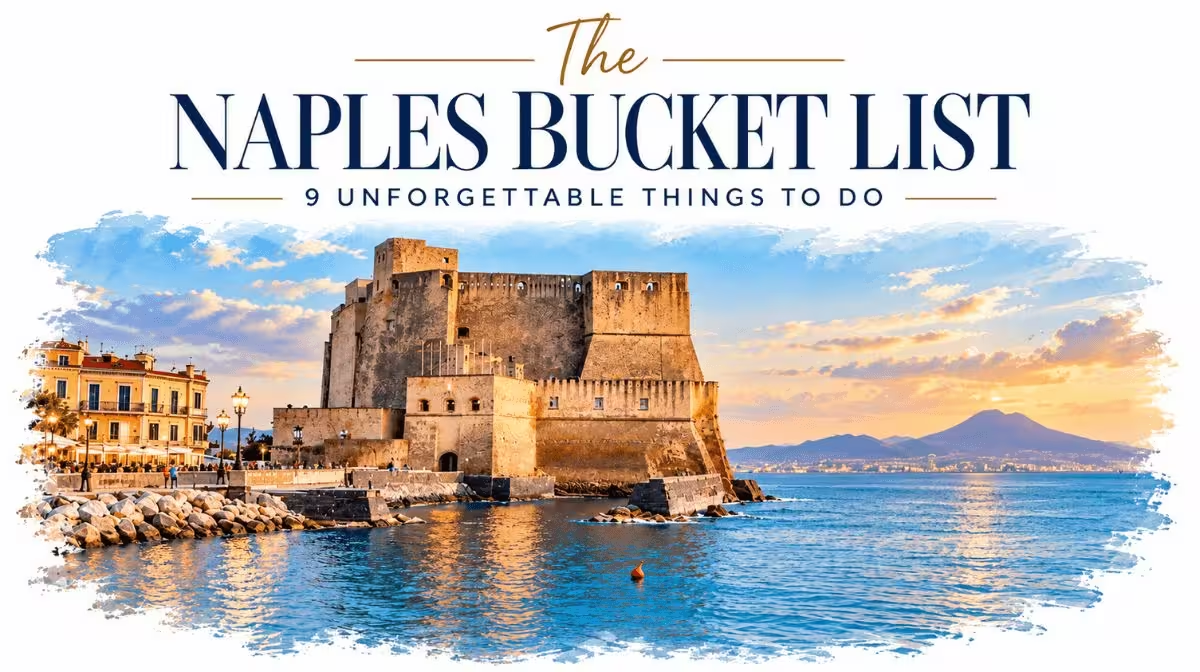
Naples’ oldest castle sits on its own tuff islet, connected to the Santa Lucia waterfront by a short causeway, with the Borgo Marinari fishing village and its restaurants clustered at the base. Legend has it the Roman poet Virgil sealed a magic egg into the foundations — hence the name, “Egg Castle” — and that as long as it stays intact, so does Naples.
A short boat tour around the gulf gets you the classic view of the castle against the Naples skyline, plus a look at a few coastal spots you can’t reach on foot.
Sail to Capri
Capri is a roughly 50-minute hydrofoil ride from Naples’ Molo Beverello port, which makes it an easy day trip rather than a whole separate leg of a trip. The island’s biggest draws are the Faraglioni, the three limestone sea stacks rising straight out of the water, and the Blue Grotto, a sea cave where sunlight refracts through the water to turn it an almost unnatural shade of blue.
Between the boat crossing, the grotto, and time in Anacapri, this easily fills a full day — get an early boat over to beat the crowds at the grotto entrance.
We visited on an earlier Italy trip, long before Naples was ever on the radar, and it’s every bit as good as the photos make it look.
Discover Procida
Procida is the smallest of the islands in the Bay of Naples, and the least touristy — it was Italy’s Capital of Culture in 2022, which nudged it onto more radars, but it’s still nowhere near as crowded as Capri. The postcard shot is Marina Corricella, a fishing harbor lined with pastel-colored houses stacked up the hillside, boats bobbing right below the front doors.
It’s about a 40-minute ferry from Naples, small enough to cover on foot in a day, and a good antidote if Capri feels a bit too polished.
Ride to Sorrento
Sorrento sits on a clifftop terrace above the Bay of Naples, close enough for an easy Circumvesuviana train ride, and it’s the traditional gateway to the Amalfi Coast. Lemon groves crowd the terraces around town — this is limoncello country — and the historic center is built for a slow wander between artisan workshops and cliffside viewpoints.
If you want to push further along the coast in the same day, a guided day trip out of Naples typically pairs Sorrento with a run along the Amalfi Coast itself, so you get both without having to plan two separate outings.
We did both Sorrento and that winding Amalfi coastal road on a previous trip — it’s one of those drives that’s worth every hairpin turn.
Explore Napoli Sotterranea
Naples sits on top of roughly 2,400 years of itself. Forty meters below the historic center, an official guided route winds through a Greek-Roman aqueduct, the remains of a Roman theater, and tunnels that were used as bomb shelters during World War II. It’s a genuinely different way to understand the city — the same tuff stone that was quarried out to build ancient Naples left behind the empty space that’s now this tunnel network.
This was the one my teenage son was most excited about, and he loved every minute of it — genuinely one of the highlights of the trip for him.
Taste Neapolitan Pizza
Naples didn’t just popularize pizza — it invented the thing you’re picturing. The Margherita, with its tomato, mozzarella, and basil standing in for the colors of the Italian flag, was reportedly made here in 1889 for Queen Margherita of Savoy. In 2017, UNESCO recognized the art of the Neapolitan pizzaiuolo as part of humanity’s intangible cultural heritage — the hand-stretching, the wood-fired oven, the whole ritual of it.

Gino Sorbillo on Via dei Tribunali is one of the most famous names in the city for it, and worth the queue if you have the time — this Margherita of ours was every bit as good as the reputation suggests.
Eating a slice at one of the city’s historic pizzerias is non-negotiable, but if you want to actually learn the technique, a hands-on class with a local pizzaiolo is the best souvenir you’ll bring home.
Also look out for pizza a portafoglio — a small pizza folded in half like a wallet and eaten as a walking snack, sold from tiny hole-in-the-wall shops around the historic center. It’s ridiculously cheap, and it did what nothing else had managed before: my pizza-skeptical teenager tried a piece of mine from one of these shops and has been asking for pizza ever since. Naples made him a convert.
Where to Stay in Naples
Chiaia is the safest bet for a first visit — leafy, upscale, close to the waterfront, and an easy walk from both the Centro Storico and the port for day trips. Centro Storico itself puts you right in the middle of the sightseeing but is noisier and busier late into the night. Vomero, up on the hill, is quieter and more residential, with a funicular ride down into the center.
Naples Bucket List FAQ
How many days do you need in Naples?
Three to four days covers the city itself plus one or two day trips. With more time, you could add Capri, Procida, and Sorrento or the Amalfi Coast without rushing any of them.
Is Naples safe to visit?
Naples is generally safe for tourists, though it has a reputation for petty theft and pickpocketing in crowded areas like Centro Storico and the train stations. Standard city precautions — keep bags zipped and in front of you, watch for scooters weaving through pedestrian streets — cover most of it.
What’s the best time of year to visit Naples?
Spring (April–June) and early autumn (September–October) bring mild weather without the peak summer heat and crowds, which is when Pompeii and Vesuvius are most bearable to walk around in.
Can you do Pompeii and Vesuvius in one day from Naples?
Yes — many guided day trips combine both, since they sit along the same route out of the city. It makes for a full day, but it’s a comfortable pairing.
Do you need to book Napoli Sotterranea in advance?
It’s not strictly required, but tours can sell out, particularly on weekends, and you can’t visit independently — a guide is mandatory. Booking ahead guarantees your slot.
Do you need a car in Naples?
No — skip it. Naples’ streets are narrow, one-way, and notoriously chaotic, with parking close to impossible in the historic center. High-speed trains like Frecciarossa and Italo connect central Naples to central Rome and other major Italian cities in under two hours, so it’s easy to get around without ever renting a car.
Planning more of your Italy trip? Check out our Italy travel guide for the wider region.