 Skip to content

Every Toronto skyline photo has the same tower in it, and every list of things to do in the city starts with the same half-dozen names. That repetition exists for a reason — but it’s worth knowing what you’re actually looking at before you queue for a ticket. The CN Tower was built to solve a broadcasting problem, not to win a height record it held almost by accident. Casa Loma was a rich man’s fantasy that bankrupted him before he ever finished it. The Distillery District is standing on the site of a whisky operation so large it once supplied a meaningful share of the British Empire’s alcohol. None of that changes what to book, but it changes what you’re looking at when you get there. Below is the full rundown — history, context, and the practical booking links — for the tours and tickets worth your time in Toronto.
Jump to a section
Compare the Top Tours
| Tour | Duration | Price From | Best For |
|---|---|---|---|
| CN Tower Skip-the-Line + Glass Floor | 1–2 hours | ~$45 CAD | First-time visitors, skyline views |
| Casa Loma Skip-the-Line Ticket | 1.5–2 hours | ~$44 CAD | History, architecture, families |
| Distillery District Food & History Walking Tour | 3 hours | ~$108 CAD | Food lovers, small groups |
| Toronto Harbour & Islands Cruise | 1 hour | ~$40 CAD | Photos, relaxed pace |
| Hop-On Hop-Off City Bus Tour | 24–48 hour pass | ~$52 CAD | Covering the most ground in a day |
| Niagara Falls Day Tour from Toronto | 9–10 hours | ~$110 CAD | A single full-day excursion out of the city |
Prices are approximate starting rates in CAD and change seasonally — check current pricing before booking.
The CN Tower
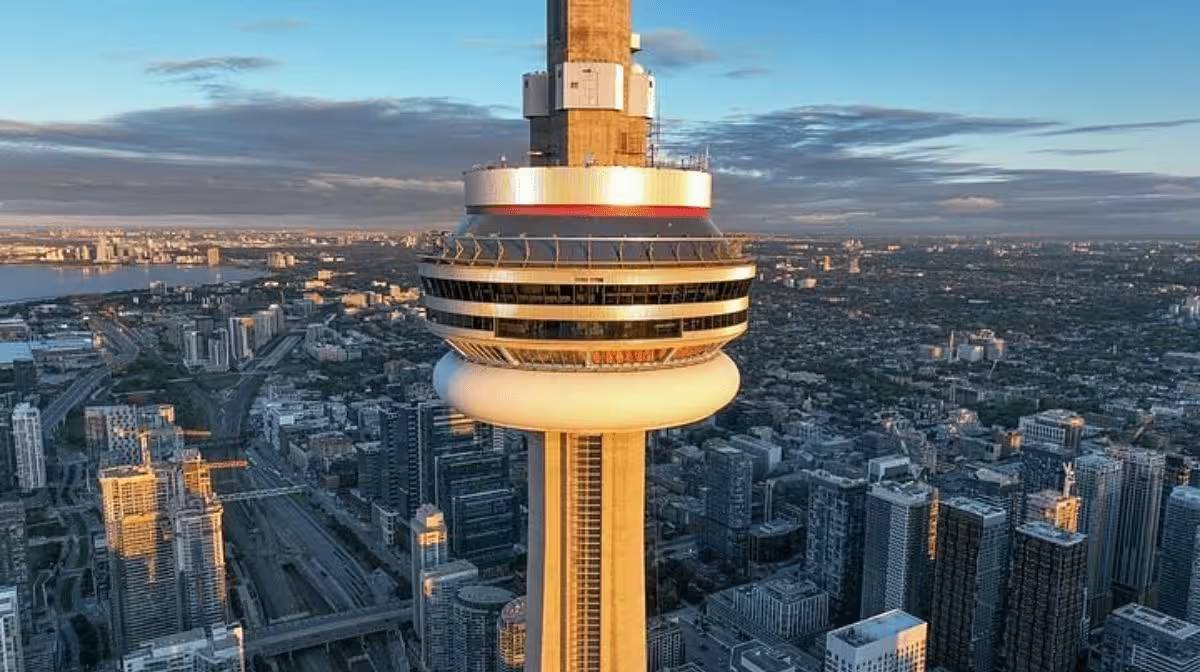
The CN Tower wasn’t built to be famous. In the late 1960s, Toronto’s skyscraper boom was creating a real problem for broadcasters — signals were bouncing off the new towers and giving the whole city poor television and radio reception. Canadian National, the railway company, proposed a fix: build a transmission tower so tall that nothing downtown could interfere with it. Construction began in February 1973 on the old railway lands, and by the time it topped out in April 1975, it had quietly become the tallest free-standing structure on Earth — a title that came from solving a signal problem, not from chasing a record.
The engineering is more interesting than most visitors realize. The tower’s three-legged base was slip-formed — poured in a continuous concrete pour that rose about six metres a day as a moving platform of forms climbed with it, day and night, for months. Its antenna, too heavy to lift by crane at that height, was flown up in 36 sections by a Sikorsky Skycrane helicopter, a spectacle that made the local papers with a printed flight schedule so people could watch. When it opened to the public on June 26, 1976, it had cost $63 million and taken 1,537 workers just over three years. It held the world’s-tallest title for over three decades, until Dubai’s Burj Khalifa surpassed it in 2007.
Worth knowing: the Glass Floor sits at 342 metres — high enough that the CN Tower’s own elevators need about 58 seconds to reach the main LookOut Level below it. The 360 Restaurant, one level up, completes a full rotation every 72 minutes, so a two-hour lunch gets you most of a loop around the city.
None of that history is why people queue for tickets, of course — they queue for the view, which on a clear day reaches roughly 160 kilometres, well into New York State across the lake. Go right at opening or in the last two hours before close, when the queue at the base is shortest and the light is best for photos.
Casa Loma
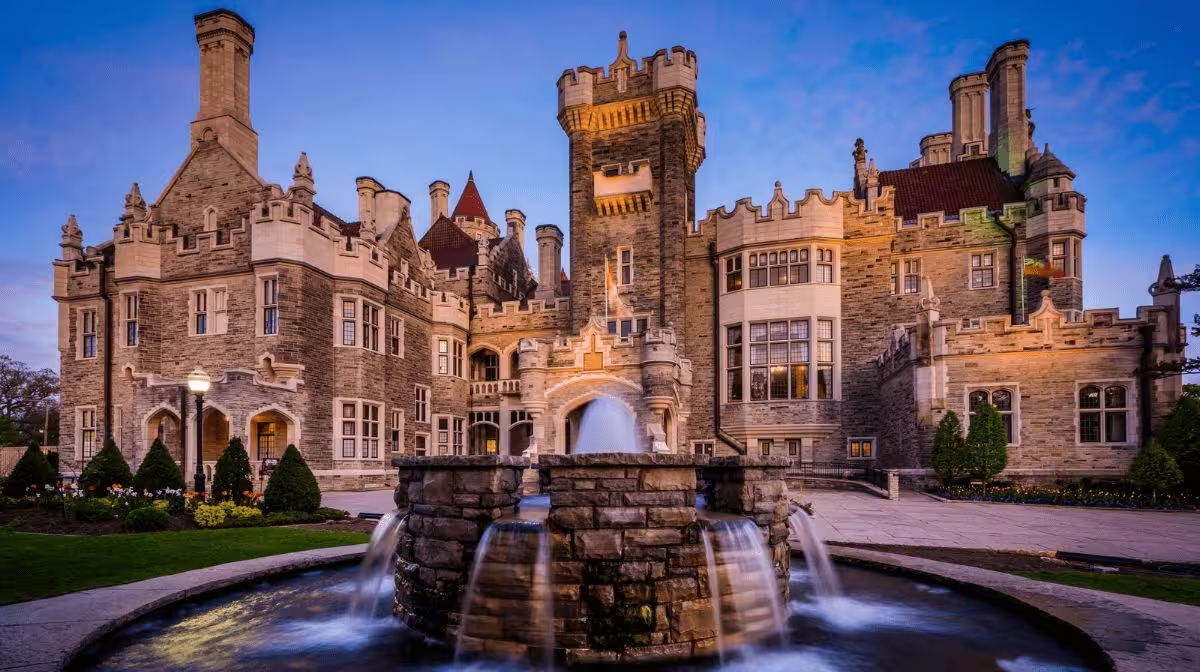
Casa Loma exists because Sir Henry Pellatt wanted to live in a castle. Pellatt was a Toronto financier who had made a fortune electrifying the city — his Toronto Electric Light Company lit the streets, and he later built one of Canada’s first hydroelectric plants at Niagara Falls. He’d been fascinated by European castles since touring them as a young man, and by 1911 he had the money and the hillside to build his own. He hired architect E.J. Lennox and gave him, by most accounts, a mandate closer to a childhood sketchbook than a blueprint — the result is a genuine Gothic Revival mansion with towers, battlements, and 98 rooms across 6,000 square metres, making it the largest private residence in Canada at the time.
The interior amenities were absurd even by the standards of the era: an oven large enough to roast a full ox, two vertical shafts built specifically to house pipe organs, a 800-foot tunnel connecting the house to the stables so Pellatt’s horses (whose names were etched in 18-carat gold) never had to be seen in the rain, and two secret passages hidden in his personal office. Construction alone ran to roughly $3.5 million in 1911 dollars — several hundred million today — and it still wasn’t finished when the First World War arrived and stopped work for good. Pellatt’s finances collapsed not long after, and by 1933 the City of Toronto had seized the property for unpaid taxes.
Worth knowing: Casa Loma was built with two purpose-built but never-completed bowling alleys and a swimming pool in the basement — 1911 ambitions that outran even Pellatt’s fortune.
What’s left is one of the more unusual museum visits in North America — a house designed by someone with more imagination than restraint, now open for exactly the wandering-through-secret-passages experience it was never quite finished for. It’s a 20-minute subway ride from downtown; the gardens, open May through September, are worth the extra half hour if the weather cooperates.
The Distillery District

In 1832, a Scottish miller named James Worts and his brother-in-law William Gooderham built a windmill on the edge of Toronto’s harbour to grind grain. It became one of the more consequential business decisions in Canadian history. Gooderham & Worts added a distillery to the milling operation a few years later, and by the 1860s it had grown into the largest distillery in the British Empire — at its 1871 peak, the company produced 2.1 million gallons of whisky in a single year, roughly half of all the whisky made in Ontario, shipped out by boat to markets as far away as Buenos Aires and Rio de Janeiro.
The site itself has a darker footnote: in 1834, Worts’s wife died in childbirth, and Worts drowned himself in the mill’s own well soon after. Gooderham took over the business alone, later bringing in Worts’s son as a partner — the company that resulted survived world war, prohibition, and a changing city for another century and a half before the last drop of alcohol was produced there in 1990.
Worth knowing: the 40-plus surviving buildings make up the largest and best-preserved collection of Victorian-era industrial architecture in North America, designated a National Historic Site of Canada in 1988.
What survived is 13 acres of red-brick Victorian industrial buildings, now a pedestrian-only district of galleries, chocolatiers, small breweries, and patios rather than mash tuns and warehouses. It’s an easy 15-minute walk from Union Station, and the cobblestone lanes and original signage make it one of the few places in Toronto where you can still see, structurally, what the 19th-century city actually looked like.
Toronto Harbour & the Islands
The Toronto Islands weren’t always islands. For centuries they were a single curved peninsula, built up over time by sand eroding off the Scarborough Bluffs to the east and carried west along the shoreline by lake currents — a landform the Mississaugas called Menecing, “on the island,” and used as a place of healing. That changed permanently in April 1858, when a violent storm cut a channel through the peninsula’s narrowest point and the connection to the mainland was never repaired. What had been a spit of sand became, by accident of weather, the chain of fifteen small islands that sits in the harbour today.
By the Victorian era the islands had become “the Coney Island of the North” — a summer escape of grand wooden hotels, amusement rides, and lakeside cottages reachable only by boat, a role they still play in a quieter form. The Gibraltar Point lighthouse, built in 1809, is one of the oldest surviving structures on the Great Lakes and still stands near where the first buildings on the islands — a British military blockhouse — went up in 1794.
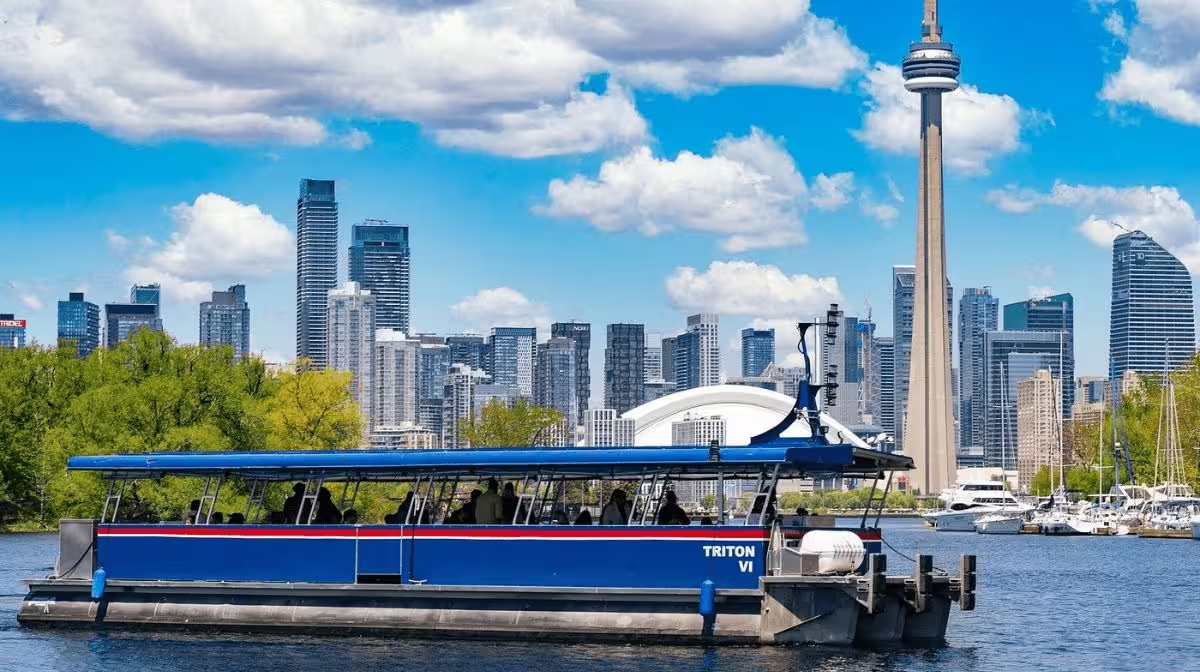
Worth knowing: the harbour cruise gives you the reverse of the CN Tower’s view — the skyline as a single frame, with the Tower itself part of the picture rather than the vantage point.
A cruise out onto the harbour today is a low-effort way to see all of this from the water — the skyline lined up behind the islands that used to be attached to it. Late afternoon sailings tend to have the best light and the smallest crowds.
Hop-On Hop-Off City Bus Tour
Less a landmark than a logistics decision: a hop-on hop-off pass strings together most of what’s on this page — the CN Tower, Casa Loma, the Distillery District, Kensington Market — on a single ticket, with a bus looping between them on a fixed route all day. It earns its place on a single tight day in the city, when the alternative is working out transit connections between four stops yourself. On a multi-day visit, walking and the subway are usually faster for any two points that are actually close together, which most of downtown Toronto is.
Niagara Falls Day Tour
Niagara Falls is geologically young by the standards of most natural landmarks — it formed around 12,000 years ago as the last ice age’s glaciers retreated and the Niagara River began cutting through the Niagara Escarpment on its way from Lake Erie to Lake Ontario. The falls have been eroding upstream ever since, historically at roughly a metre a year before hydroelectric diversion slowed the flow and, with it, the erosion. Horseshoe Falls, the larger and more photographed of the two, sits almost entirely on the Canadian side — one of the rarer cases where the better view of a shared natural wonder belongs to the other country.
It’s about a 90-minute drive from Toronto, making it a genuine full-day trip rather than an add-on to a city itinerary — most tours run nine to ten hours door to door, including a boat ride to the base of the falls. See the dedicated Niagara Falls day trip guide for the full breakdown, including the self-drive option.
Where to Stay
Downtown and the Harbourfront put you closest to the CN Tower, the Distillery District, and the harbour cruise docks — all walkable. Casa Loma is midtown, a short subway ride from either base. Full neighbourhood breakdown in the Best Hotels in Toronto guide.
Frequently Asked Questions
How many days do you need for the main Toronto tours?
Two full days covers the CN Tower, Casa Loma, and the Distillery District comfortably, with time for the harbour cruise. Add a third day if Niagara Falls is on the list.
Is the CN Tower worth it if you’re also doing a harbour cruise?
Yes — they show different things. The Tower gives you the aerial view of the whole city and lake; the cruise gives you the skyline itself, with the Tower as part of the view rather than the viewpoint.
Can you visit Niagara Falls without a car?
Yes. A guided day tour or the GO Train plus a local shuttle both work without renting a car — see the dedicated Niagara Falls day trip guide for the comparison.
Do the CN Tower and Casa Loma need to be booked in advance?
Booking ahead isn’t strictly required outside peak summer weekends, but it skips the ticket queue at both and locks in a time slot, which matters if the day’s itinerary is tight.
What’s the best time of year for the harbour cruise?
May through October, when boats run more frequently and the Islands are in full bloom. Outside that window, check the operator’s schedule before planning around it.
Is the Distillery District walkable from downtown?
Yes — it’s about a 15-minute walk from Union Station, or a short streetcar ride if you’d rather not walk after the CN Tower.
Route & Stay is reader-supported. Some of the links on this page are affiliate links, and we may earn a small commission if you book through them, at no extra cost to you. Tour details and prices were accurate at the time of writing but can change — always confirm current availability before booking.