 Skip to content

If you are working out where to stay in Sorrento, the short answer is Piazza Tasso for a first visit, Sant’Agnello for calm and sunsets, and Marina Grande for a fishing-village feel. Sorrento sits on cliffs above the Bay of Naples, with ferries to Capri and trains to Pompeii, so it works as a base for the whole region. This guide compares the three areas, picks three luxury hotels, and covers the ferry and train details that make the stay easier.
In this guide
Sorrento at a glance
How Sorrento is laid out
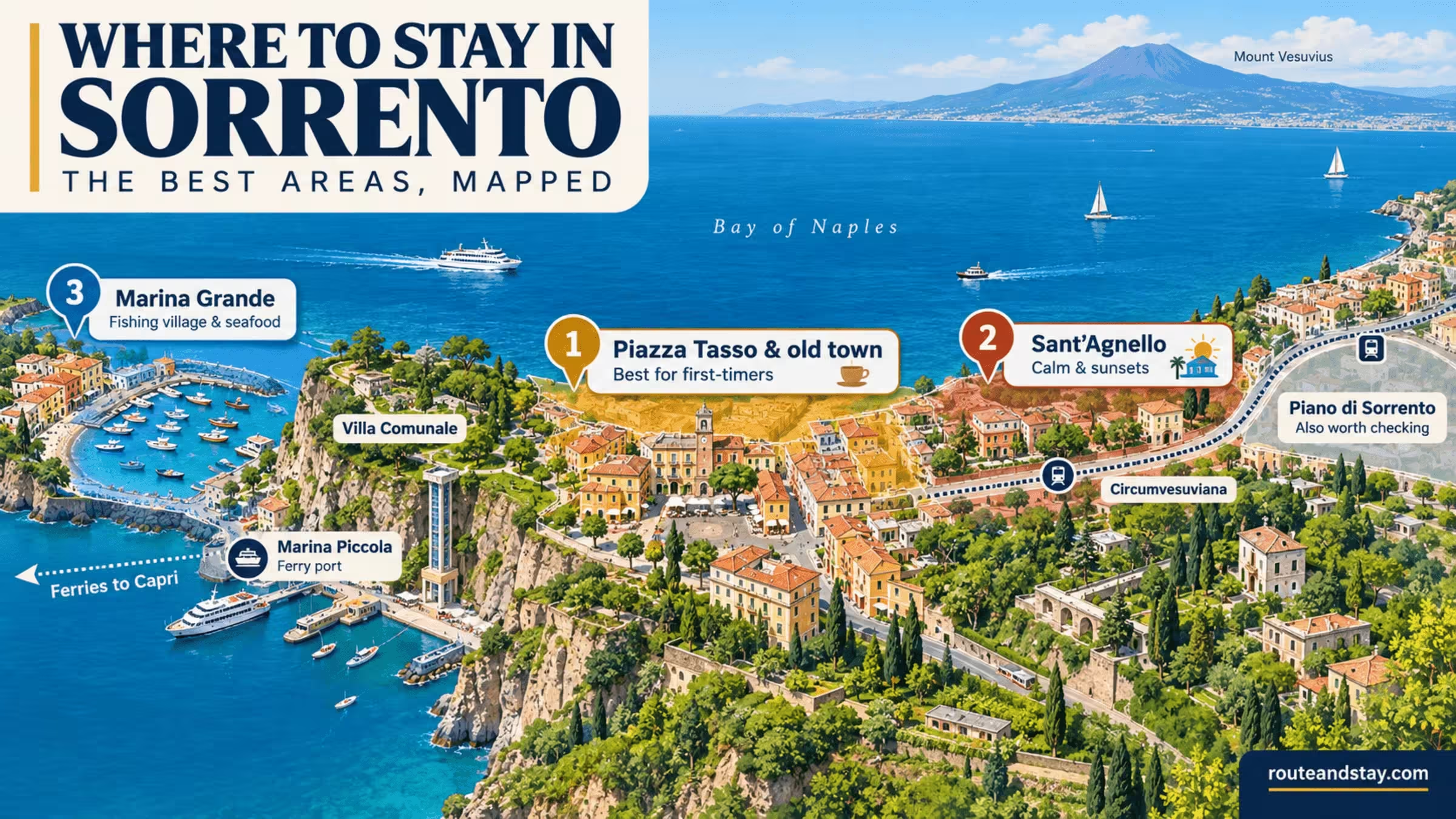
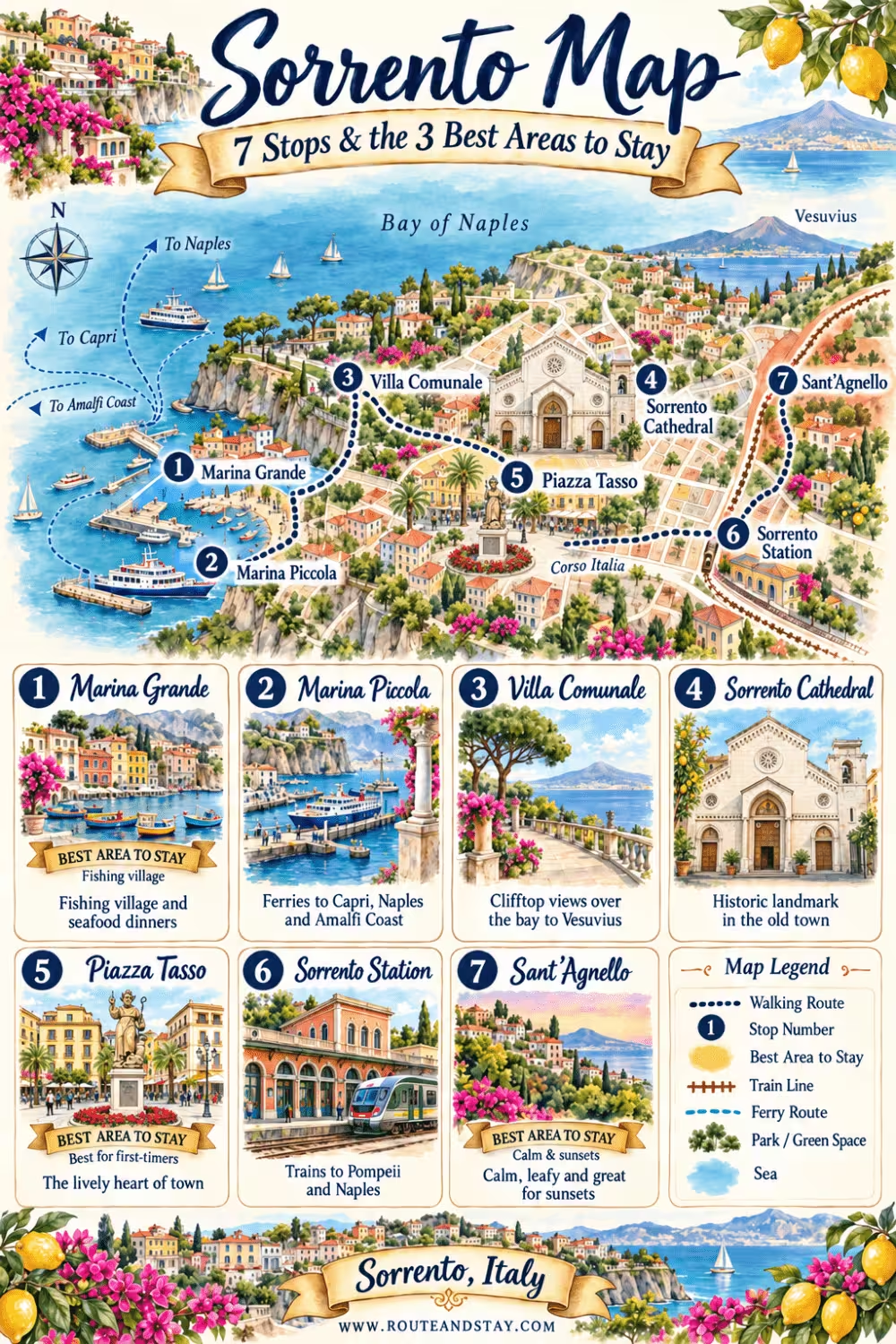
Sorrento sits on top of tall cliffs above the Bay of Naples, with the old town and its shops on the plateau and the sea far below. That shapes everything about where you stay. The centre is compact and easy to walk, but the two harbours sit at the bottom of the cliffs: Marina Piccola on the east side is the ferry port, and Marina Grande on the west side is the old fishing village. The park at Villa Comunale has a public lift down to Marina Piccola, which saves a long walk with luggage or on a ferry morning.
The town’s history goes back a long way. The Romans called it Surrentum, and the poet Torquato Tasso, who wrote Gerusalemme Liberata, was born here in the 16th century. Tourism took off in the 19th century, when visitors such as Lord Byron and Friedrich Nietzsche came to the Bay of Naples. That heritage is why many of the best hotels are old villas and palaces on the cliff edge rather than modern blocks.
Piazza Tasso and the old town: the best base for first-timers
Piazza Tasso is named after the poet and is the town’s main square. The old town’s lanes start here, and they are lined with cafes, restaurants and shops selling lemon products, ceramics, lace and inlaid wood, all long-standing Sorrento crafts. The Circumvesuviana station and the buses to the coast are a short walk away, so you can sightsee on foot and reach your day trips without a taxi.
Within a short walk of the square you can reach:
- Villa Comunale park: a clifftop garden with views over the bay to Vesuvius and one of the most popular places in town to watch the sunset. The public lift to Marina Piccola starts here.
- Chiostro di San Francesco: a quiet cloister next to the park, planted with flowers and often used for weddings and, in summer, concerts and art shows.
- Museo Correale: paintings and porcelain in an 18th-century residence, with a terrace overlooking the sea.
- Sorrento Cathedral: a 14th-century church with a facade rebuilt in 1924.
- Museo Bottega della Tarsia Lignea: on Via San Nicola, a museum in an 18th-century palazzo that explains Sorrento’s inlaid wood (marquetry) tradition.
Sorrento is often called the limoncello capital of Italy. Lemons are grown all around the town, and the cold, sweet digestif is served after dinner almost everywhere. Look for the baked pasta known as gnocchi alla sorrentina on local menus.
- Best for: first-timers, shoppers, short stays and anyone relying on trains, buses and ferries.
- Keep in mind: evenings are lively and rooms facing the square or main lanes can be noisy, so ask for a quieter room at the back.
Sant’Agnello: quiet luxury and sunset views
Sant’Agnello is a small separate town that runs straight on from Sorrento along the same stretch of coast, about 25 km from Naples. It has its own Circumvesuviana station, which makes it one stop from Sorrento, and it has a quieter, more residential feel than the centre. The American novelist Francis Marion Crawford lived here from 1887 until his death in 1909, in the house now known as Villa Crawford.
Today it is a calm base of gardens, villas and clifftop hotels, with some of the best views of the Bay of Naples and Vesuvius. You are a short train ride or roughly a 20-minute walk from the centre, so you can have a peaceful hotel and still reach Piazza Tasso for dinner. The trade-off is fewer restaurants and shops on your doorstep, so plan your evenings.
- Best for: couples, honeymoons and travellers who want a calm escape from the day-tripper crowds.
- Keep in mind: you will rely on the train, a taxi or a longer walk for dinner and sightseeing, so check the last trains if you plan a late night.
Marina Grande: the old fishing village
Marina Grande is Sorrento’s small fishing village at the foot of the cliffs, west of the centre. It is known for its colourful wooden boats, including the traditional Gozzi Sorrentini that have been built here for centuries, and for its pastel waterfront houses and views across the bay to Vesuvius. At its heart is the church of Sant’Anna, a popular wedding venue.
It is about a 10 to 15 minute walk from the centre, finishing with stone steps down to the water. There is no lift here, unlike at Marina Piccola, so the walk back up is a climb. Buses run from Piazza Tasso, and taxis are easy to find if you do not want to walk. The small beach has dark volcanic sand and a beach club, and swimming is limited to a roped-off area because of boat traffic. The seafood restaurants along the water, such as Il Gozzo, Nduli and the beach-club restaurant at Bagni Sant’Anna, are the main reason to stay or eat here.
- Best for: food lovers and travellers who want an old-Italy feel with a quieter evening scene.
- Keep in mind: there are fewer hotels than in the centre, and the steps make it harder with heavy luggage or limited mobility.
Which area suits you?
| Area | Best for | Vibe | Eating out | Walk to Piazza Tasso | Getting around |
|---|---|---|---|---|---|
| Piazza Tasso | First-timers | Lively, central | Dozens of options on foot | 0 to 5 min | Station and buses close |
| Sant’Agnello | Couples, calm | Quiet, villas | Fewer options, hotel restaurants | About 20 min, or one train stop | Train or taxi |
| Marina Grande | Foodies | Fishing village | Seafood on the water | About 10 to 15 min, steps back up | On foot, bus or taxi |
Walking times are approximate and depend on your exact hotel.
If the three areas are fully booked or too expensive, Piano di Sorrento, the next town along the same train line, is another quieter option worth checking on the map below.
How many nights should you stay?
Two nights is enough to see Sorrento itself: the old town, the park and cloister, a sunset and a seafood dinner by the water. Most travellers stay three to five nights because the town is such a convenient base. Capri, Pompeii and Herculaneum, and the Amalfi Coast are each a full day, so three days of trips plus a rest day or two makes a comfortable week. If you are only passing through on the way to Positano or Capri, one night near the station or the ferry is the easiest way to avoid a rushed morning.
Three luxury hotels in Sorrento
If you want to splurge, these three are the classic clifftop choices. Each has a lift down to the sea or beach level, which matters in a town built on cliffs.
Luxury · Piazza Tasso
Grand Hotel Excelsior Vittoria
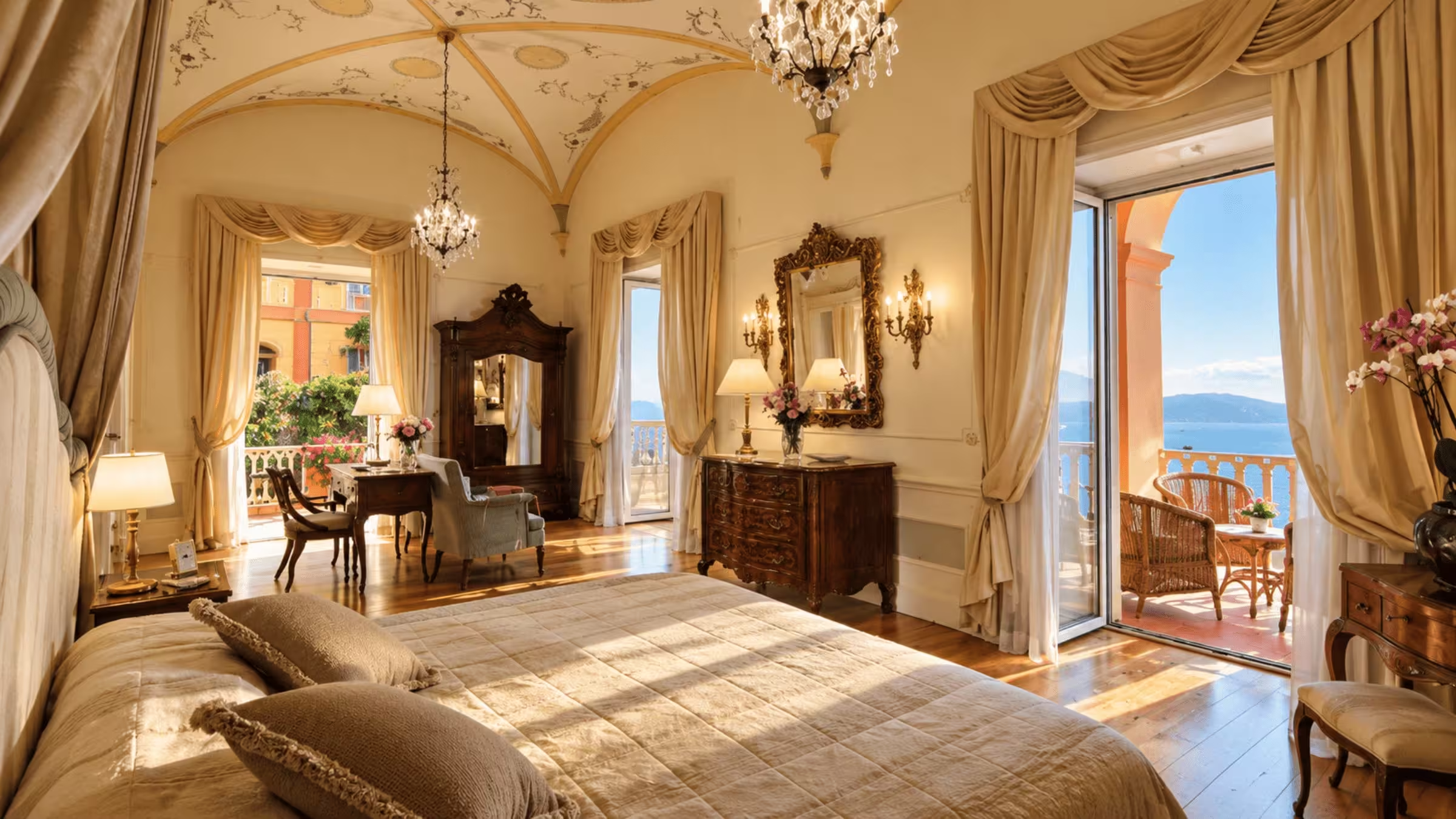
A historic hotel made up of three villas built between 1834 and 1880, set in orange groves and gardens just off Piazza Tasso. Wagner stayed here, and the singer Enrico Caruso lived here for a time in the 1920s. Roman columns found during construction stand in the garden, a private lift runs down to the seafront and harbour, and the Terrazza Bosquet restaurant holds a Michelin star. There are 81 rooms, all with balconies over the gardens or the bay, and a spa in a former 19th-century greenhouse.
Check availability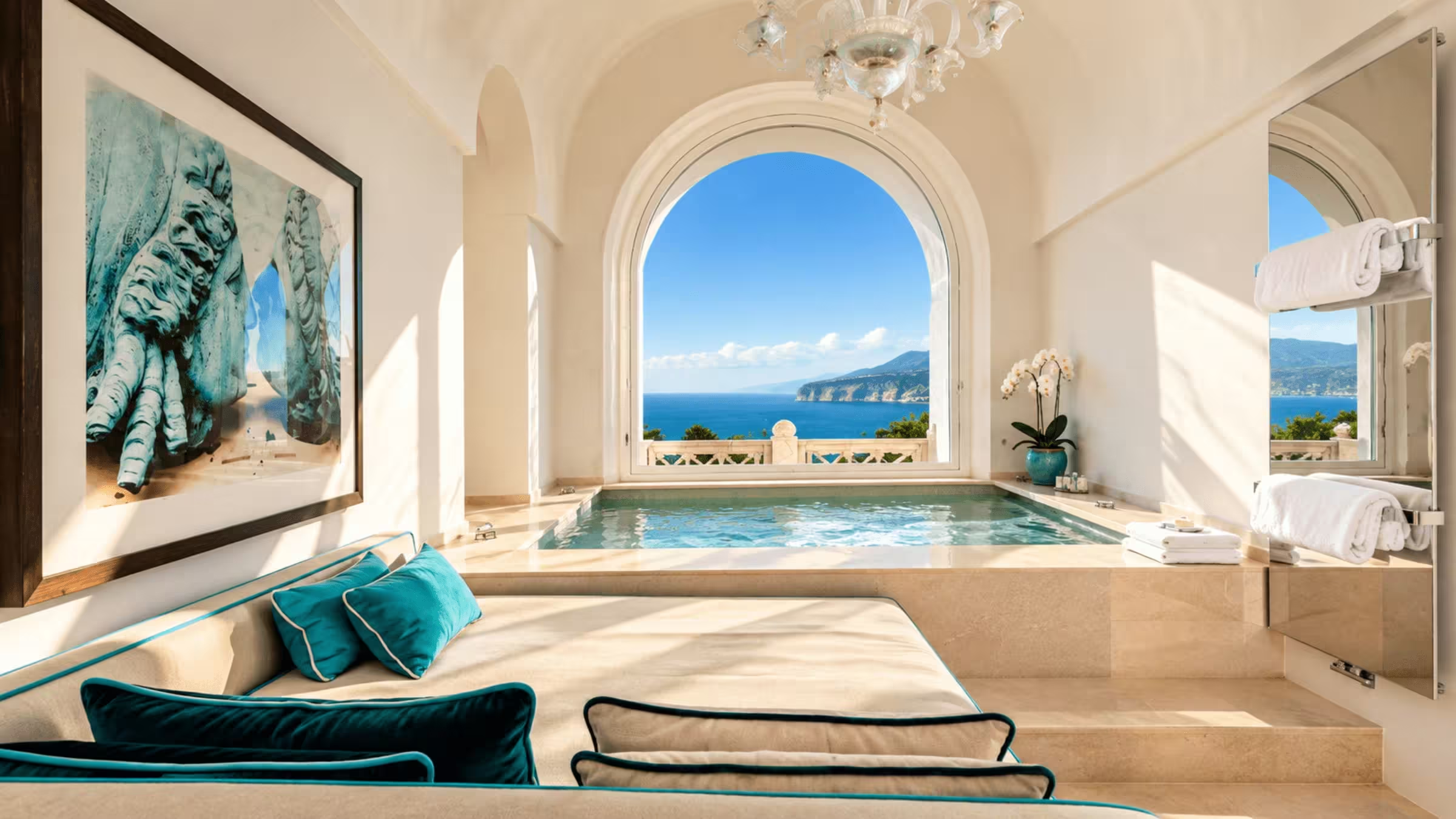
Luxury · Clifftop, about 10 min walk
Bellevue Syrene 1820
A Relais & Châteaux hotel dating from 1820, said to stand on the remains of an ancient Roman villa. It sits on the cliff about a ten-minute walk from Piazza Tasso, with sea-view rooms and Murano glass chandeliers. A lift leads down to a private seafront jetty with a bar, and the gourmet restaurant Mimmo Jodice is open to non-guests too.
Check availability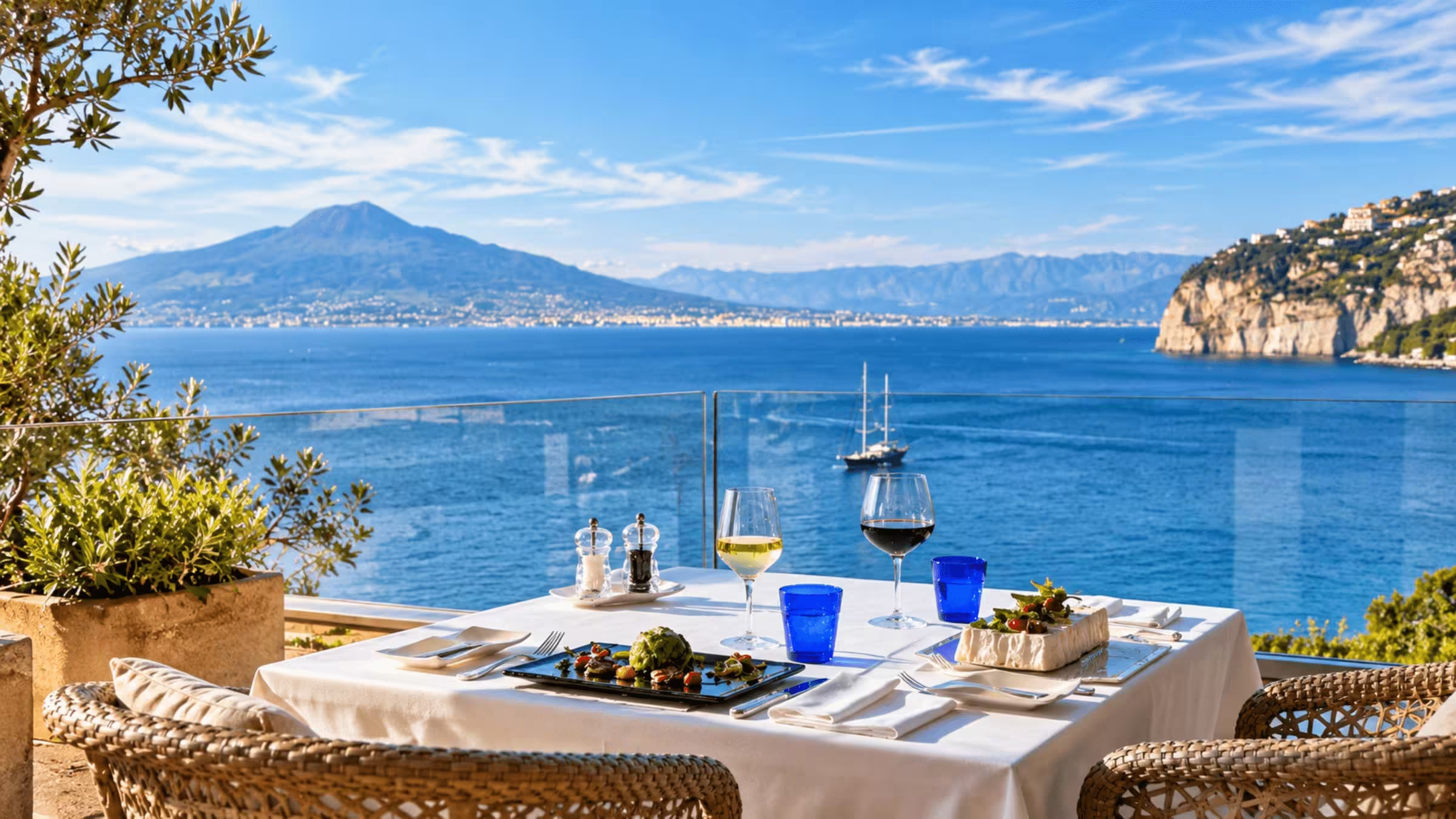
Luxury · Gardens near the centre
Grand Hotel Royal
A classic grand hotel on Via Correale, a short walk from the heart of town and on the same street as the Museo Correale. Landscaped gardens, a pool and a lift down to sea level make it a good choice if you want five-star service close to Piazza Tasso rather than out on the headland.
Check availabilityWhat to check before you book a Sorrento hotel
- Lifts and steps. Many hotels are on the cliff edge or on a hill. Ask how far the hotel is from the road, whether there are steps, and whether the lift reaches your floor.
- Air conditioning. Summers are hot, so confirm it is included and working rather than assumed.
- Noise. Rooms above lanes or the main square can be loud late. Ask for a courtyard or garden-facing room.
- Distance to the station or ferry. If you are doing early day trips, a ten-minute walk to the Circumvesuviana or a lift to Marina Piccola is worth more than a sea view.
- Parking. If you are driving, check whether parking is included, how much it costs and whether the hotel is in a limited-traffic zone.
- City tax and breakfast. Both are often charged at the hotel and are not always included in the headline price.
Getting to Sorrento and getting around
- From Naples by train: the Circumvesuviana runs from Napoli Garibaldi and Porta Nolana to Sorrento, and the faster DD services take around 50 minutes. Tickets are cheap, but trains can be crowded and there is no luggage storage, so heavy bags are awkward.
- Campania Express: a tourist-oriented train on the same line with reserved seating. Reports say it has been suspended from 1 October 2026 until further notice, so check the EAV website before planning around it.
- Private transfer: for a luggage-heavy arrival from Naples airport or station, a private driver is simpler. Prices usually fall around €110 to €130 one way, but confirm when you book.
- By ferry: ferries leave from Marina Piccola, below the cliffs and a couple of kilometres by road from the centre. The easiest way down is the public lift from Villa Comunale park, then a short walk along the harbour. You can also take a taxi or local bus, or use your hotel’s lift if it has one.
- To Marina Grande: buses run from Piazza Tasso, and taxis are easy to find. There is no lift, so most people walk down and take a taxi or bus back up.
- Best time to visit: May to early October suits beach and boat days. September is a good balance, with warm sea and fewer crowds than July and August.
Book a private transfer to Sorrento
Day trips from Sorrento: Capri, Pompeii and the Amalfi Coast
The real reason many travellers choose Sorrento is how easily it connects the ruins to the north with the islands and coast to the south.
Capri
Fast ferries to Capri leave from Marina Piccola, so Sorrento is one of the easiest bases for the island. Our Capri day trip guide covers ferry tips, a day plan, the Blue Grotto and boat tours.
Pompeii and Herculaneum
The Circumvesuviana to Pompei Scavi–Villa dei Misteri takes roughly 30 to 40 minutes from Sorrento. Herculaneum (Ercolano Scavi) is further along the same line towards Naples. Buy tickets at the station or through EAV’s app, and check the timetable because some trains skip stations. Our Pompeii and Vesuvius guide covers tickets, opening hours and a day plan.
The Amalfi Coast
SITA Sud buses run from Sorrento to Positano and Amalfi, but the coast road is narrow and can be slow in summer. Seasonal ferries and guided tours are the easier alternatives.
Looking for tours, private transfers or boat trips? See the day trip options in our Sorrento Travel Guide.
Booking tips for Sorrento
- Book early for summer. The best clifftop hotels sell out well ahead from June to September.
- Check access. Sorrento is built on cliffs, so ask about lifts, steps and step-free routes before you book.
- Expect a city tax. It is usually paid at the hotel and varies by category and season.
- Pick free cancellation. It keeps your options open while you finalise ferries and tours.
- Choose by location first. A sea view is lovely, but a hotel near the station or Piazza Tasso saves time on day trips.
Live hotel map
Compare Sorrento hotels and apartments by area and price for your dates.
Frequently asked questions
What is the best area to stay in Sorrento for first-time visitors?
The area around Piazza Tasso. Cafes, shops, restaurants and the old town are all on foot, and the train station and bus stops are a short walk away. If you want something calmer, Sant’Agnello is one train stop or a short walk along the coast.
How many nights should you stay in Sorrento?
Two nights is enough to see the town itself. Most travellers stay three to five nights, because Capri, Pompeii and Herculaneum and the Amalfi Coast are each a full day trip from Sorrento.
Is Marina Grande a good place to stay?
It suits food lovers who want a quiet fishing-village feel. It has fewer hotels than the centre, and the walk back up to town is steep with no lift, so it is less convenient with heavy luggage or early ferry mornings.
Is Sorrento a good base for the Amalfi Coast?
Yes, with a caveat. Buses run from Sorrento to Positano and Amalfi, but the coastal road is narrow and slow in summer. Seasonal ferries or a guided tour can be easier than the bus, and Sorrento also gives you quick access to Capri and Pompeii, which Positano does not.
Do I need a car in Sorrento?
No. The centre is walkable, and trains, ferries and buses cover the main day trips. Driving the Amalfi Coast road in high season is slow and parking is limited, so most visitors are better off without a car.
How far is Sorrento from Pompeii and Capri?
Pompeii is roughly 30 to 40 minutes by Circumvesuviana train to Pompei Scavi–Villa dei Misteri. Capri is about 20 to 40 minutes by fast ferry or hydrofoil from Marina Piccola, depending on the operator.
Is Sorrento safe at night?
Sorrento is generally regarded as a relaxed, walkable town in the evenings, with busy streets around Piazza Tasso. Take the usual precautions with valuables, especially on crowded trains.
Keep planning your Italy trip
Route & Stay contains affiliate links. If you book through them we may earn a commission at no extra cost to you. Prices, availability and hotel details can change, so confirm them on the booking page before you travel.